Platform history · Companies and technology
Dreamcast reached the future before broadband did
A modem in the box, a screen in the memory card, an arcade-to-home bridge—and an early hardware exit. The story of why a correct idea still needs the right ecosystem at the right time.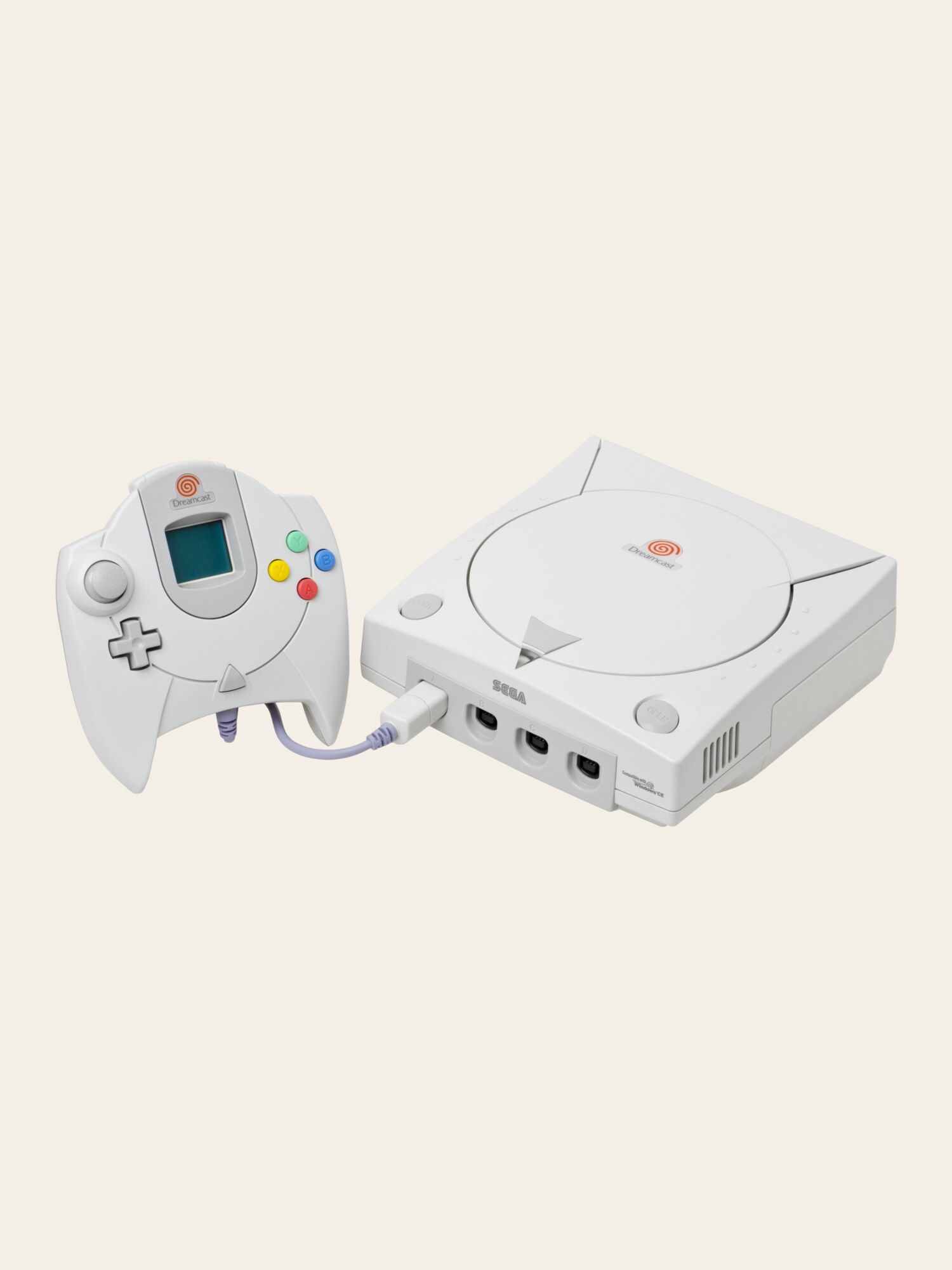
Picture a 1998 home console that connects from the box, browses the web, sends mail, supports network play and carries a memory card with its own screen and portable software. That is not a modern wish list; it is the Dreamcast proposition documented in Sega’s hardware archive.
Yet a machine that recognised the future did not secure its own. That is the useful tension: innovation opens a door, but timing, distribution, capital, content and network adoption decide whether an audience can walk through it.
When connection became part of the machine’s meaning
Sega launched Dreamcast in Japan on 27 November 1998 at ¥29,800 and built a removable 33.6Kbps modem into the standard hardware. With Dream Passport, the console could browse, handle email and chat, and connect to network services. The internet was not a vague future accessory; it was part of the platform identity.
This was not today’s frictionless broadband. A phone line constrained speed and household use, while services varied by territory and title. The historical strength is not the number 33.6; it is the design decision that a console should expect a community and service layer, not only discs and a display.
Visual Memory: a second screen before second screens were ordinary
Visual Memory was not silent storage. Sega documents an LCD, file management, personal-viewer and small portable-game functions, plus direct exchange between two units. Inserted into the controller, its display remained visible through a dedicated window.
The clever idea was not a large or advanced screen. It was that game data left the television with the player. A character, score or miniature experience could become a continuing relationship. Companion apps and secondary displays later made that logic familiar; Dreamcast placed it inside a memory card.
The bridge from arcade floor to living room
Dreamcast combined an SH4 processor, PowerVR2 graphics, 16MB main memory and roughly 1GB GD-ROM media. More important culturally, Sega’s NAOMI arcade board was compatible with the console architecture, helping its arcade expertise travel home and enabling experiments with linked save data.
The console therefore behaved less like an isolated box and more like a Sega network: arcade, home, portable memory, peripherals, storefront and services. Keyboards, mice, microphones, cameras and maracas turned the platform into a laboratory for input beyond a standard pad.
Before Discord and digital storefronts: an ecosystem in miniature
Sega records dricas, Dreamcast Direct and Dream Library alongside browsing, mail, chat and connected play. Japan’s DreamEye supported video conversation and photo/video mail, while a 10Base-T Broadband Adapter replaced the removable modem on supported setups. Not every experiment reached the same audience, but the breadth is revealing.
In 2000, Phantasy Star Online delivered a 3D network RPG connecting players around the world, according to Sega’s series portal. The point is not that Dreamcast invented all online play. It is that Sega assembled hardware, services and social identity inside a home console when that package was not yet obvious.
The convenient myth: ‘PS2 killed it by itself’
Sega acknowledges the difficulty of challenging PlayStation’s market position, a 1999 price cut, and its 31 January 2001 announcement that the home business would focus on content while Dreamcast production ended with the fiscal year. Those are facts. One-rival explanations erase the more complicated interaction of capital, distribution, developer confidence and network timing.
Being early can itself be expensive: modems, services and peripherals need infrastructure, support and users together. A correct idea can arrive before the market can finance it. Dreamcast’s lesson is not simply ‘the better machine lost’; it is that product and ecosystem must mature together.
PLAYLORE PLATFORM NOTE
Five ideas ahead of their familiar form
Dreamcast did not invent everything that followed; it assembled these ideas unusually early inside one platform.| Idea | Dreamcast form | Later familiar form | Contemporary limit |
|---|---|---|---|
| Network by default | Modem and Dream Passport | Platform accounts and connected services | Slow dial-up and territory variance |
| Second screen | Visual Memory in and out of the controller | Companion apps and secondary displays | Tiny screen and separate batteries |
| Arcade ↔ home | NAOMI compatibility and save experiments | Shared engines and assets across hardware | A Sega-specific ecosystem |
| Voice and picture | Microphone and DreamEye | Platform voice/video social layers | Optional hardware and limited services |
| Digital distribution | Dream Library and network services | Digital stores and libraries | Early speed, storage and rights constraints |
COLLECTOR GUIDE
Buying a Dreamcast now? Buy testable condition
This is ageing hardware, not a guaranteed ornament. Ask for clear operational evidence before paying a nostalgia premium.- Identify hardware, game region and the voltage printed on the unit; never assume compatibility.
- Request a startup video showing a known disc, audio, picture and controller ports.
- Check model label, cables, controller and Visual Memory Unit separately.
- Match video output to your display; VGA and HDMI are not the same label, and support varies by game.
- Treat original online play as history, not a promised service; verify any community server or modification independently.
- Choose a seller with an explicit condition report and returns; ‘rare’ is not a verified price.
Two links only for completing an existing setup
Amazon.sa comparison searches without retailer images or unverified prices. Third-party products vary; verify model, region, video signal and returns.
Dreamcast-to-HDMI video adapter
A possible route to a modern display. Check signal type, game support and exact model instead of relying on the HDMI word alone.
Compare on Amazon.saReplacement Dreamcast controller and VMU
For an incomplete setup. Confirm original versus third-party status, condition, connector and required batteries.
Compare on Amazon.saAs an Amazon Associate I earn from qualifying purchases.
Primary sources
Sources and verification
Specifications and history come from Sega’s official archive; the real photograph is CC BY-SA 3.0. Pages were opened and checked on 16 August 2026.PLAYLORE ARCHIVE
Continue through the PlayLore archive
PLAYLORE VERDICT
The future is not a feature; it is an ecosystem
Dreamcast gathered ideas that now look logical: connection, social identity, secondary display, digital content and movement between devices. It also reminds us that vision is not adoption, and arriving first does not mean remaining last.
The best way to honour it is not to make it flawless folklore. Read what it actually did—and what it needed but could not find in time. Dreamcast then becomes more than a short-lived console: it becomes a long-lived lesson in platform design.